← Back to Joel & Nanz
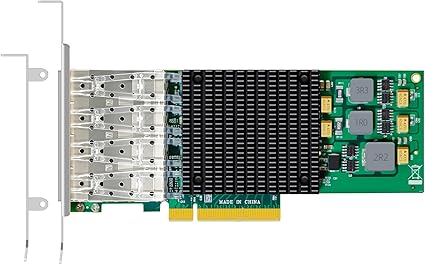
GLOTRENDS ST7322 4-Port 10Gb SFP+ Network Card (Ethernet PCIE NIC) with Broadcom BCM57840 Controller, PCIe 3.0 X8 Interface
179.00 CAD
Servers and high-bandwidth networking builds needing four 10G SFP+ ports on a Broadcom BCM57840 controller for fiber or DAC connectivity.
Buy on Amazon.ca →You'll be taken to Amazon.ca to complete your purchase.
About this product
Key features
- 4-port 10G ethernet network card with Broadcom BCM57840 controller, support SFP+ optical modules and corresponding DAC/AOC cables, PCIE 3.0 X8 interface, Low & Regular-profile bracket
- Automatic negotiation speed (10GbE/1GbE data rates), Full Duplex (Not Half Duplex)
- Virtualization Features: Next-generation NPAR, SR-IOV, Linux KVM Multiqueue , NVGRE MSI-X vector port, EVB, Geneve
- Manageability Features: PXE, UEFI, iSCSI, NCSI. Remote boot over iSCSI, PXE and UEFI, not support Wake on Lan (WOL)
- OS Compatibility: Windows 10/11, Windows Server 2012/2016/2019/2022/2025, Linux, VMWare ESXi : 6.5 U3 or 6.7 U2
Affiliate disclosure: This product links to Amazon. As an Amazon Associate, Joel & Nanz Inc. earns from qualifying purchases at no extra cost to you.
Specifications
- Model
- GLOTRENDS ST7322
- Ports
- 4x SFP+ (10Gb each)
- Speed
- 10Gbps per SFP+ port
- Connector
- SFP+ (fiber or DAC)
- Interface
- PCIe 3.0 x8
- Controller
- Broadcom BCM57840
Pros
- ✓Four 10G SFP+ ports for high aggregate bandwidth
- ✓Broadcom BCM57840 enterprise controller
- ✓SFP+ supports fiber or DAC for low-power, cool operation
- ✓PCIe 3.0 x8 for full multi-port throughput
Cons
- ×SFP+ requires transceivers or DAC cables (not included)
- ×BCM57840 driver setup can be more involved on some OSes
- ×PCIe 3.0 x8 slot recommended for full four-port speed
FAQ
What controller does the ST7322 use?
It uses the Broadcom BCM57840, an enterprise-grade 10G controller, across four SFP+ ports.
Does it include transceivers?
No, SFP+ cards require separate SFP+ optical transceivers or DAC (direct attach copper) cables to connect.
What slot does it need?
It uses a PCIe 3.0 x8 interface; install it in an x8 or larger slot for full four-port bandwidth.